Göbekli Tepe and the Origins of Science – III – Martin Sweatman
Overview
Göbekli Tepe and the Origins of Science – III
***
***
Göbekli Tepe and the Origins of Science – III
4. Why the Calendar Matters
Without the calendar, the date-stamp interpretation remains plausible, even highly likely, but not totally convincing. This is because one can reasonably argue that the central disk symbol could represent something else, and that such extremely early evidence for this kind of astronomical knowledge is just as highly unlikely.
The specific configuration of surrounding animals alone cannot counter that argument with complete confidence. Pillar 19’s «Sun and cresent Moon» symbols strengthen the astronomical interpretation considerably, but do not seal the deal.
However, the calendar shows it is almost certainly correct. Its arithmetic naturally terminates at the disk. Once that happens, the interpretation of the disk as the Sun is no longer a weak assumption. It emerges from the Pillar itself.
Conversely, the date-stamp interpretation explains something that the calendar alone cannot. Why was such a sophisticated lunar-solar calculation carved onto this particular pillar? If the purpose were merely to record the length of the year, why encode it on Pillar 43. In fact, the calendar occupies exactly the place where it can perform its interpretive role. It guides the reader towards identifying the central disk as the Sun, allowing the rest of the composition to be understood.
The two systems therefore appear to have been designed together.
Solving the combined puzzle
The calendar and the date-stamp should not be viewed as separate discoveries that just happen to occupy the same place on Pillar 43. A better analogy is a crossword puzzle. One answer helps solve another.
The calendar leads naturally to the disk as the Sun.
The Sun makes the constellation map and date stamp more convincing.
The date stamp, in turn, explains why the calendar is present.
Each interpretation increases confidence in the other. This is not circular reasoning. Two largely independent observations—the animal carvings and the geometric symbols—are analysed separately before converging on the same interpretation of the central disk. It is precisely because the two arguments begin from different evidence that their agreement becomes significant.
Scientists often encounter this kind of convergence when several independent experiments point towards the same explanation. No single observation is decisive, but together they become increasingly persuasive. Pillar 43 appears to exhibit the same logical structure.
Beyond Coincidence
Scepticism is entirely appropriate when interpreting prehistoric symbolism. Any single resemblance between an animal and a constellation might be coincidental. Likewise, any isolated numerical pattern risks becoming an exercise in seeing meaning where none exists.
The strength of the proposed interpretation lies in its ability to account simultaneously for features that would otherwise remain unrelated.
Why do the animal symbols resemble a familiar astronomical pattern?
Why do the geometric symbols produce a coherent count of the solar year?
Why does that count terminate exactly at the central disk?
Why does interpreting the disk as the Sun suddenly make sense of both the astronomical imagery and the calendar?
These questions are answered together by the same simple idea.
This kind of convergence is often the hallmark of a successful scientific explanation because it accounts for diverse observations more simply than treating each one separately. This is the essence of Occam’s Razor, also called «parsimony» or «explaining power» by scientists. It is the foundation of the scientific method – to explain complex information in a simple way.
That, ultimately, is why the astronomical interpretation of Pillar 43 deserves such careful attention.
5. Before Writing: Recording Knowledge
Art can be interpreted in many different ways. Its meaning is often personal, symbolic or emotional. A carved fox may simply represent a fox. A circle may represent the Sun, or the Moon, or completeness, or any number of other ideas.
Communication is different. For communication to work, symbols must carry reasonably consistent meanings. A reader must be able to recognise that one symbol stands for one idea and another for something else. The more consistent those relationships become, the closer we move towards writing.
More Than Decoration
Modern readers are accustomed to separating pictures from writing. Books contain words; paintings contain images. Ancient societies often made no such distinction.
Egyptian hieroglyphs are pictures. Chinese characters evolved from pictures. Early Mesopotamian writing began as pictures (Encyclopedia Btiannica, Sumerian Writing). In each case, familiar images gradually acquired conventional meanings that allowed increasingly complex ideas to be expressed.
Pillar 43 may represent a much earlier stage in the same process.
The individual carvings remain recognisable as animals and geometric figures, yet together they appear capable of communicating something far more abstract: the relationship between the Sun, the stars and the passage of time. That is why it is more accurate to speak of proto-writing than writing itself.
A Shared Symbolic Vocabulary
If this interpretation were confined to Pillar 43 alone, it would remain difficult to evaluate its importance. Fortunately, similar symbols appear elsewhere (Sweatman, 2020, 2024).
Throughout Göbekli Tepe the same animals recur repeatedly. Foxes. Birds. Snakes. Scorpions. Circular symbols. H-shaped motifs. V-shaped marks. This repetition suggests that the symbols belonged to a shared visual vocabulary rather than representing isolated artistic choices.
Nearby sites strengthen that impression. At Sayburç, only a short distance from Göbekli Tepe and of broadly similar age, reliefs include the familiar Master-of-Animals motif together with symbolic imagery recalling themes already established at Göbekli Tepe. The celebrated Urfa Man statue, one of the oldest life-sized human sculptures ever discovered, also bears the distinctive V-shaped mark that appears on Pillar 43. If the interpretation proposed here is correct, this mark may already have carried an accepted symbolic meaning connected with time or a particular day. And at Kutik Tepe, stone jars record symbols similar to some of those on Pillar 43 (Benz and Bauer, 2015).
Together, these examples suggest that these symbols belonged to a broader symbolic tradition across the region in southern Anatolia at this time.
Echoes Through Time
Several thousand years later, remarkably similar ideas appear to persist across the ancient Near East, typically accompanied by circular or semi-circular motifs.
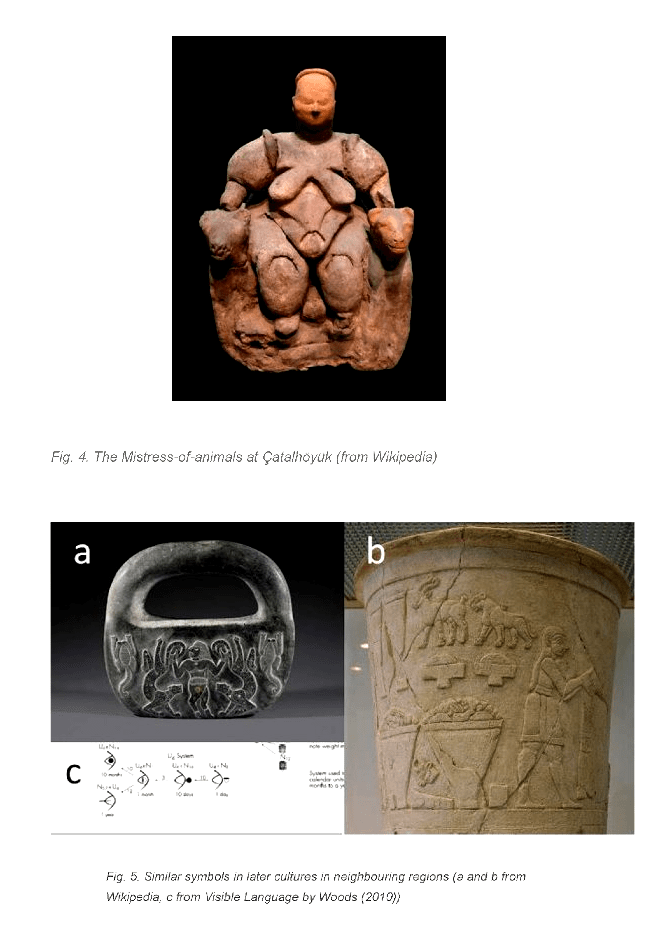
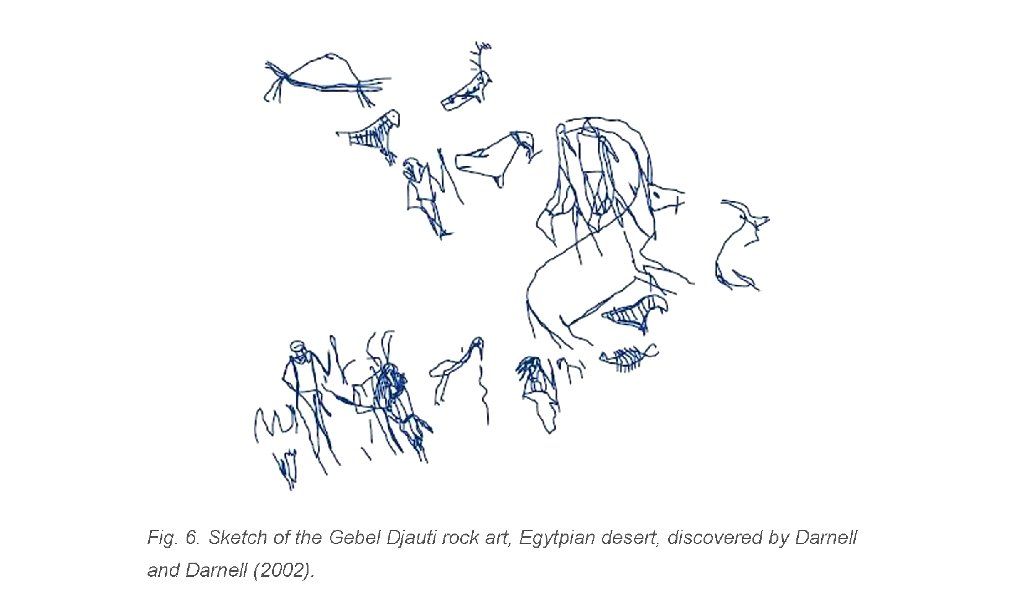
At Çatalhöyük, the Mistress-of-animals and circular motifs are prominent (see Figure 4). In southeastern Iran, the carved stone objects of Jiroft (Figure 5a) with semi-circular handles depict the Master-of-Animals (Counts and Arnold, 2010) flanked by wild creatures in compositions that recall much earlier Anatolian imagery. The famous Uruk Vase (Figure 5b) combines animals with semi-circular forms in ways that some scholars have interpreted astronomically (Hartner, 1965). Early proto-cuneiform (Figure 5c) employs semi-circular signs associated with both the Sun and units of time. Predynastic Egyptian rock art (Figure 6) likewise preserves combinations of birds, scorpions, serpents and semi-circular symbols that invite comparison with Pillar 43.
*
*
*
Taken together, these examples suggest that a symbolic language linking animals, celestial motifs and time became widespread across the ancient Near East during the following millennia. Göbekli Tepe now appears to stand at, or near, the beginning of that tradition.
Recording Ideas Instead of Objects
The earliest writing systems were developed largely to manage increasingly complex societies. They recorded livestock, grain, taxes and trade.
Pillar 43 appears to pursue a different objective: the heavens. Instead of counting possessions and property, it appears to count days and record time.
That difference may tell us something important about the earliest motivations for symbolic communication. Long before writing became an administrative tool, people may have sought ways to preserve observations that mattered to their understanding of the natural world. And, especially, they may have sought to memorialise a great catastrophe that needed to be recorded and remembered for furture generations.
If so, Pillar 43 represents something profoundly human. It is an attempt to ensure that knowledge survives its creators. It could also be an attempt to warn future generations about the existential dangers they face.
***
Martin Sweatman
Dr. Martin Sweatman is Scientist at University of Edinburgh. Reader in Chemical Engineering in the School of Engineering [University of Edinburgh]
__________________
Café Montaigne thanks Dr. Martin Sweatman for his kind and generous contribution. Full undivided article has been originally published on July 01, 2026 in https://martinsweatman.blogspot.com/2026/07/gobekli-tepe-and-origins-of-science.html.




![«El teatro musical breve: el espectáculo folclórico de los años 40, 50 y 60», de María Jesús Pérez Ortiz – Texto introductorio de Juan Cabezas Moreno [Alhama Comunicación] & Grabación videográfica de la presentación del libro [Jueves 11 de Diciembre de 2025 / Sala Eduardo Ocón / Sala Fundación Unicaja María Cristina – Fundación Unicaja – Málaga] & Apunte radiofónico de Radio Alhama n Internet [RAi – 21 de Febrero de 2026] – Cortesía de María Jesús Pérez Ortiz & Diario Digital Comarca de Alhama [Málaga]](https://cafemontaigne.com/wp-content/uploads/MJPO-248x165_c.jpg)