Göbekli Tepe and the Origins of Science – II – Martin Sweatman
Overview
Göbekli Tepe and the Origins of Science – II
***
***
Göbekli Tepe and the Origins of Science – II
3. The Second Clue: A Calendar Hidden in Plain Sight
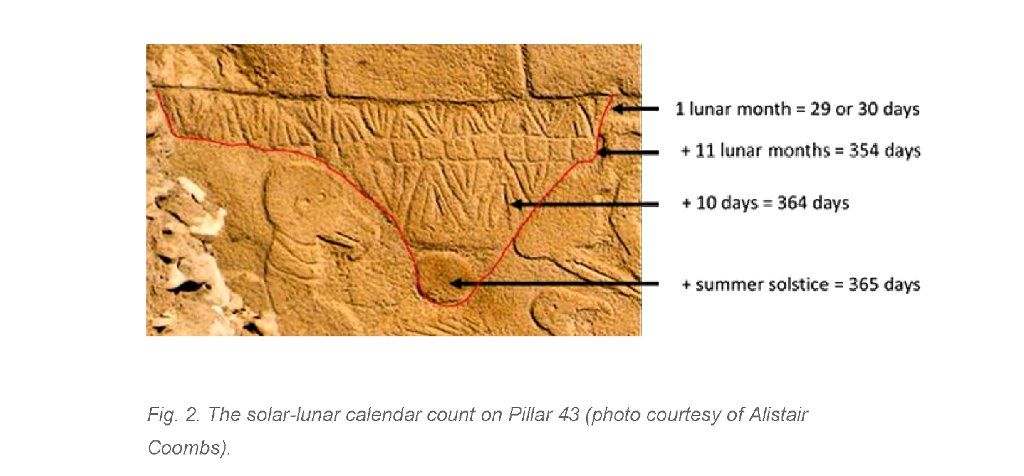
Running across the top of the pillar is a sequence of V-shaped marks (see Figure 2). Beneath them are eleven small square symbols, followed by another group of V-shapes that lead the eye towards the large circular disk at the centre of the composition. The same disk that is already thought to represent the sun.
*
*
For years these geometric symbols received relatively little attention. Yet they present a puzzle every bit as intriguing as the animals below them. Are they counting something?
Indeed, they do look like a tally. The most natural candidate is time. Alexander Marshack in the 1970s thought that many marked sticks and other artifacts from the Palaeolithic period were also counting time, often the lunar cycle, so this idea has precedence (Marshack, 1972).
Following the Count
The sequence begins with fourteen pairs of V-shaped marks with alternating vertical orientation. The design concludes with a single V on the right, giving a total that naturally reads as either twenty-nine or thirty. It’s twenty-nine if you count 15 upright Vs in one direction and 14 upside-down Vs back again. But it’s 30 if you only count the upright Vs in both directions.
That number is immediately interesting because it corresponds to the length of a lunar month (Gordon, 2021). In fact, the Moon follows a cycle averaging about 29½ days. Since antiquity, many cultures have alternated months of twenty-nine and thirty days to keep their calendars aligned with the changing phases of the Moon.
If the upper row represents one lunar month, then the eleven squares beneath acquire an obvious role. They probably indicate that the same lunar cycle should be repeated eleven more times (Sweatman, 2024).
Twelve lunar months amount to 354 days.
Below the squares lies another sequence of ten V-shaped marks.
Adding these brings the total to 364 days.
Directly beneath the count sits the large circular disk.
One more day completes a solar year of 365 days.
Suddenly, the entire geometric design becomes clear. It appears to record the cycles of the Moon and the Sun within a single visual construction in the form of a summation. Indeed, the calendar appears to encode a basic arithmetic:
(29 + 30)/2 * (1 + 11) + 10 + 1 = 365
If this interpretation is correct, the key question is why is it there? There is no obvious reason to carve an elaborate lunar-solar calculation onto one face of a monumental pillar already covered with symbolic imagery. The calendar appears unnecessary. Unless, that is, its purpose was never to function as a practical calendar.
Solving the Puzzle
Imagine encountering Pillar 43 without knowing the meaning of its symbols. You notice the animals and circles and the strange rows of V-shaped marks. But, it’s not immediately obvious that the central disk represents the Sun rather than the Moon, a star, an egg, a head or anything else.
But then you begin counting.
The upper sequence produces the length of a lunar month. The middle section repeats it twelve times. The lower sequence completes the year, minus one day. The final day is supplied by the disk itself. The conclusion is obvious.
The disk almost certainly represents the Sun on a special day in the year.
Specifically, it represents the completion of the solar year – perhaps the summer solstice. So, the calendar tells the reader how to interpret one of the pillar’s most important symbols. This, perhaps, is its true purpose. Rather than serving as a functioning calendar, the sequence serves as a device for reading the monument correctly: the disk is the Sun.
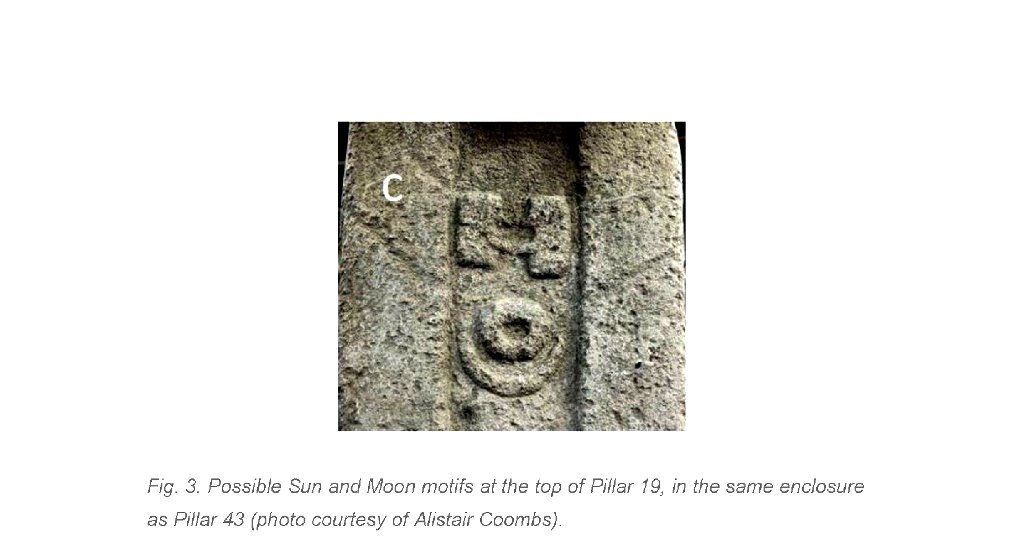
Another Pillar in the same enclosure, Pillar 19, reinforces this conclusion. Under the horizontal «head» of this giant five-metre stone T-pillar is a circle next to a crescent (see Figure 3). Although the circle in this case has a hole in it, this pair have an obvious interpretation as the Sun and crescent Moon. These are popular motifs among many cultures. Indeed, astronomy is generally held to be important for many shamanistic cultures, and the considered view among the site’s excavators is that its symbolism exhibits many of the hallmarks of shamanism. So an astronomical reading of its symbols should be considered favourably.
*
*
A Stone Checksum
Computer scientists use the term checksum to describe a piece of information whose primary purpose is not to carry new data, but to verify that the rest of a message has been interpreted correctly. The analogy is not exact, but it is helpful.
The geometric symbols on Pillar 43 appear to function in much the same way. They lead the reader towards an inescapable conclusion about the meaning of the central disk. Once that conclusion is reached, the astronomical imagery surrounding it becomes much easier to understand.
Two Clues Become One
The date-stamp interpretation and the calendar interpretation are mutually supporting. Earlier we saw that the arrangement of animals appears to identify a particular date. But that interpretation depends on recognising the central disk as the Sun.
The calendar now provides an entirely different route to exactly the same conclusion.
This is the point at which the two lines of evidence converge. The calendar explains how to identify the Sun and, therefore, how to read the astronomical date. The animal carvings explain when the event occurred.
Neither interpretation proves the other. But together they form what philosophers of science call consilience: independent observations converging on a single explanation. That is what makes the astronomical interpretation so compelling. It is solved because two quite different clues appear to fit together with unexpected precision.
***
Martin Sweatman
Dr. Sweatman is Scientist at University of Edinburgh. Reader in Chemical Engineering in the School of Engineering [University of Edinburgh]
__________________
Café Montaigne thanks Dr. Martin Sweatman for his kind and generous contribution. Full undivided article has been originally published on July 01, 2026 in https://martinsweatman.blogspot.com/2026/07/gobekli-tepe-and-origins-of-science.html.




![Educar tras Auschwitz [Con motivo de la celebración del Día Internacional de Conmemoración Anual en Memoria de las Víctimas del Holocausto y del octogésimo aniversario de la liberación del Campo de Concentración y Exterminio de Auschwitz-Birkenau – 27 de Enero de 2025] – Sebastián Gámez Millán](https://cafemontaigne.com/wp-content/uploads/A-B-248x165_c.jpg)