Göbekli Tepe and the Origins of Science – I – Martin Sweatman

Overview
Göbekli Tepe and the Origins of Science – I
***
The material may have been previously published also on the Foundation’s website https://www.forumviatoris.org.pl/]
***
Göbekli Tepe and the Origins of Science – I
How a prehistoric monument may change our understanding of the origins of astronomy, writing, civilisation, and science.
1. The Discovery
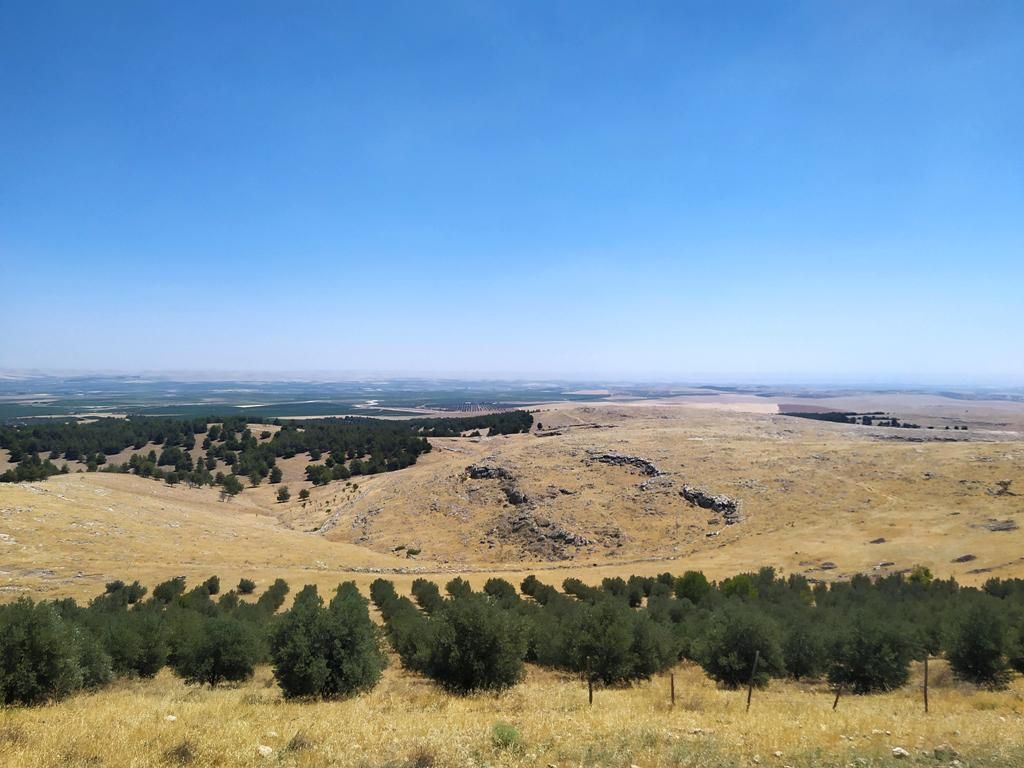
On a limestone ridge overlooking the Harran Plain in southeastern Turkey stands one of the most remarkable archaeological sites ever discovered: Göbekli Tepe. Its massive stone pillars were erected more than 11,500 years ago, making them older than Stonehenge by six millennia and older than the Egyptian pyramids by at least seven (Deitrich, 2013). They also predate pottery, metallurgy, writing and, perhaps most surprisingly, established agriculture.
For much of the twentieth century, archaeologists believed they understood the sequence that led to civilization. Farming was established first. Reliable food production allowed permanent settlements to develop. Villages became towns, populations grew, labour became specialised and, eventually, societies acquired the resources needed to build monuments, invent writing, develop mathematics and study the heavens systematically.
Göbekli Tepe overturns that story. It shows that monument building was established before, or perhaps alongside, agriculture. Communities living just before the dawn of the Neolithic quarried limestone pillars weighing many tonnes, transported them across the hilltop and erected them in carefully planned circular enclosures. Whatever social organisation made this possible, it was far more sophisticated than archaeologists had imagined for this period.
Even more startlingly, many of the pillars are covered with finely carved animals—foxes, birds, snakes, scorpions, wild boar and others—together with a smaller collection of geometric symbols whose meanings remained elusive. These carvings were often interpreted as symbolic or religious art, a reasonable view given the apparent ceremonial nature of the site.
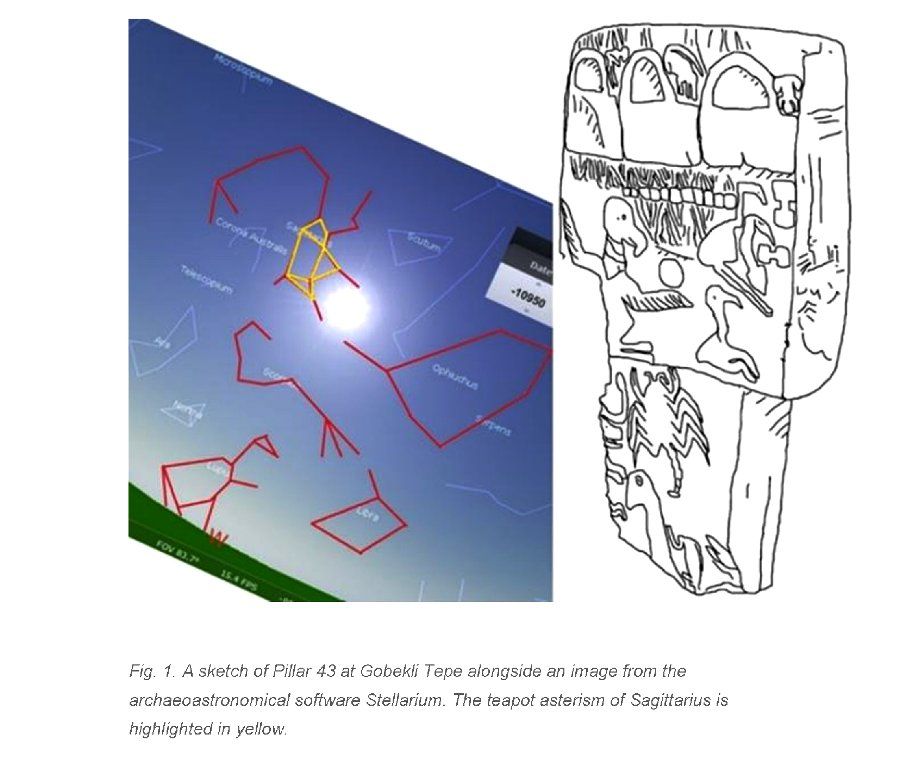
But, what if some of these carvings were intended not simply to decorate the monuments, but to communicate information? Klauss Schmidt, the site’s original lead excavator thought this was likely (Schmidt, 2011), but could not unlock their meaning. However, over the past decade, a new and remarkable interpretation of one pillar in particular—Pillar 43, often known as the Vulture Stone—has emerged. And it is based on astronomy (see Figure 1):
*
*
2. The Puzzle of Pillar 43
Among the many decorated pillars uncovered at Göbekli Tepe, one has attracted particular attention. Pillar 43, probably the most elaborate of all the pillars uncovered so far, presents an intricate composition of birds, a scorpion, a canid, several other animals, circular and semicircular symbols, and an unusual sequence of V-shaped marks. The symbols appear to be deliberately chosen and placed as though each contributes to a larger design.
The most immediately recognisable figure is a scorpion. Above it stands a large bird supporting a prominent circular disk. Nearby are another bird grasping a snake, a dog-like animal, several quadrupeds and three semicircular symbols arranged across the upper part of the pillar.
There reason why these particular animals should appear together is not immediately obvious. Possibly, they represent creatures of symbolic or religious importance, or they tell a myth now lost to history.
But another possibility should also be considerd. For thousands of years people have imagined the stars as animals. The familiar constellations of Scorpius, Sagittarius, Pisces, Gemini and Virgo are only one example of a much older human tendency to organise the night sky into recognisable figures. Different cultures chose different animals, but the underlying principle is universal: the stars become easier to remember, and therefore more useful, when they are associated with familiar forms.
Suppose, then, that the animals on Pillar 43 instead represent constellations. Given that Göbekli Tepe features several megalithic circles, and that many ancient megalithic circles have been connected with astronomy (e.g. Stonehenge), this possibility should be considered favourbaly. Several astronomical correspondences immediately become apparent.
The scorpion naturally resembles Scorpius. The large bird carrying the disk occupies a position comparable with the «teapot» asterism of Sagittarius. The canid lies where Lupus appears in the sky. Another bird grasping a snake recalls Ophiuchus, traditionally associated with a serpent. Other figures bear suggestive similarities to Pisces, Gemini and Virgo.
Of course, these individual correspondenses could be coincidental. But when considered together, they resemble one region of the sky far more closely than would be expected if they had been selected independently.
Furthermore, the animal symbols have a specific arrangement around the central disk. If that disk represents the Sun, then the pillar might depict more than just a straightforward picture of the sky.
Earlier research (Sweatman and Tsikritsis, 2017) showed that this arrangement corresponds particularly well with the sky on the summer solstice around 10,950 BCE, close to the beginning of the Younger Dryas, a period of abrupt climatic change recognised throughout the Northern Hemisphere. Therefore, Pillar 43 could function as a kind of date stamp for an extraordinary event.
The date stamp and precession
To see how this works, we first need to understand the phenomenon of precession of the equinoxes.
Anyone who watches the heavens carefully over the course of a year quickly learns that the Sun picks out a regular path through the zodiacal constellations – this can be inferred by observations shortly before sunrise and shortly after sunset. Every year it reaches the same solstitial and equinoctial constellations, marking the changing seasons. But there is another, much slower cycle that only becomes apparent over many generations.
The Earth’s axis slowly wobbles, rather like a spinning top. As a result, the solstitial and equinoctial constellations drift gradually through the background zodiac. Astronomers call this phenomenon the precession of the equinoxes.
The movement is extraordinarily slow: one full cycle takes almost 26,000 years. Nevertheless, even within one lifetime this motion is noticable.
By mapping the constellations against the sun on a specific day, like the summer solstice, the arrangement effectively records one position within the long precessional cycle. In other words, it functions as a date stamp. The three animals next to the semi-circles at the top of the pillar are then likely to represent the three other solsricial and equinoctial constellations in the year.
Gurshtein, a russian astronomer, had already predicted a similar kind of zodiacal dating, which uses the four cardinal constellations only, might have existed in the middle Neolithic period (Gurshtein, 2005). But Pillar 43 appears to dsiplay an even more sophisticated design at a much earlier time by mapping the precise location of the sun against the constellations.
What’s so important about this date?
Although unproven, there is a prominent scientific proposal that the Younger Dryas climate change was triggerred, and perhaps reinforced, by a catastrophic cosmic impact with a fragmented comet (Firestone et al., 2007).
Therefore, the astronomical interpretation of Pillar 43 suggests that it could record the date of an epoch-defining catastrophe. An event so devastating that it demands to be recorded and remembered for generations. Then, Pillar 43 would function as a grand memorial stone, much like those we continue to erect today.
Indeed, Pillar 43 could be telling us why Göbekli Tepe itself was constructed. Perhaps its builders were highly motivated by a new belief system that was also triggered by the Younger Dryas impact (Sweatman, 2019). An event of this magnitude would have created widespread and intense fear and wonder, sufficient to have initiated a renewed interest in the cosmos, questions about existence and powerful celestial beings.
But that interpretation has been contested by many. Both the interpretation of the animal figures as constellations similar to the Greek ones we still use, and the overall design as a date stamp, are thought by some to be far too early in the archaeological record. This is because both the Greek constellations and the phenomenon of precession of the equinoxes, on which this astronomical interpretation rests, were thought to have been creations of classical Greece at least 7500 after Göbekli Tepe was abandoned.
Moreover, the Younger Dryas Impact Hypothesis is hotly debated. So, this astronomical interpretation of Pillar 43 intrudes into many scientific debates where it is not welcomed by many. Not only does Göbekli Tepe upend conventional thoughts about the origins of civilisation, but it potentially re-writes the history of astronomy and contributes to our understanding of how major geological periods may relate to Earth’s place in the cosmos.
But Pillar 43 has even more extraordinary secrets to reveal. Consider now its geometric symbols.
***
Martin Sweatman
Dr. Martin Sweatman is Scientist at University of Edinburgh. Reader in Chemical Engineering in the School of Engineering [University of Edinburgh]
__________________
Café Montaigne thanks Dr. Martin Sweatman for his kind and generous contribution. Full undivided article has been originally published on July 01, 2026 in https://martinsweatman.blogspot.com/2026/07/gobekli-tepe-and-origins-of-science.html.